Agile methodology

Introduction

Waterfall model follows application development in phases with checkpoint and deliverable documents in each checkpoint. It advocates rigours project management, strategy and processes to track the status. The main drawback is that it require more than 80% project understanding before kick off the project which is impossible in major cases. Cause of volatile requirements and understanding business feels, 80% of software projects using this methodology fail to meet their objectives. Continue reading “Agile methodology”

Canonical Data Source

When we define SOA strategies at an enterprise level, we deal with multiple Line of Business (LOB) systems; some of them will be dealing with the same kind of business entity as well. This necessitates a Common Data Model (CDM) or Canonical Data Model.

SOA creates an environment where different types of data must work together. This makes application development complex. Service Data Object (SDO) provides a very simple programming model that addresses this issue. The key high level advantages of SDO are:

  • Uniform access to data from heterogeneous sources which could be XML, RDB, POJO, SOAP, etc.
  • SDO provides both a static (or strongly typed) programming model and a dynamic (or loosely typed) programming model. This provides a simple programming model without sacrificing the dynamic model needed by tools and frameworks.
  • Provides Meta-data for easy introspection of data types
  • Supports a disconnected model, whereby data can be retrieved from a data source via Data Access Service. The data can be modified by a client with change tracking, and applied back to the data source.
  • SDO programming model is language neutral
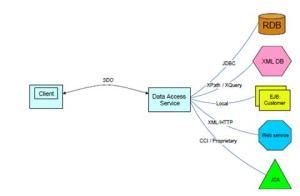
Hetrogeneous Data Source


References

Improve Performance by caching and compression

Web page designs are becoming innovative with rich interface which involve extra code such as java scripts, css, and images etc. Most of the end-user response time tied-up in downloading these components.Optimizations of number of http requests and response size are the key parameters to improve the web application performance. Continue reading “Improve Performance by caching and compression”

Enterprise Benefits on Service Oriented Architecture – SOA

Currently, the market push is towards SOA, or Service-Oriented Architecture. SOA as a term is impressive but we need to understand what benefit we can achieve using SOA. Before turning towards benefit, it is necessary to discuss common understanding.  In brief, a service oriented architecture is paradigm which include service as a layer whereas service which is nothing but individual functionality that is shared across the applications.
The primary goal of Service Oriented Architecture is to align business users with information technologies (IT).
Adopting Service Oriented Architecture realizes many benefits..Click To Read More!

Template engine on Web development

A template engine is a generic tool used on web development to process web templates and content information to produce output web documents. Template Engine as a processor is most frequently used in the context of development for the web


e.g. XSLT is a template processing model designed by W3C. It is designed primarily for transformations on XML data (into web documents or other output).
There are many open source template engine available to generate web document such as
  1.  Free Marker: http://freemarker.sourceforge.net/
  2.  Apache Velocity: http://velocity.apache.org/

Benefits:

  1. High Maintainability: Predefined “templates” which can be changed easily. 
  2. Separation: It separate your business logic from your presentation design
  3. Clean & Standard code:  Standard based on template design
  4. Consistent UI coding:  Developers have to always follows template design for UI development
  5. High Reusability : Reuse existing template across the application UI development